Start with hydraulic flow, not the attachment
Every powered attachment draws on the loader’s auxiliary hydraulic circuit, and the flow that circuit delivers sets the ceiling on what the machine can run. A mulcher or cold planer rated for high-flow hydraulics will underperform, or stall, on a machine set up for a standard flow. Before buying an attachment, match its rated flow and pressure to the loader’s auxiliary output.
This is also the first thing to confirm when comparing a track loader for sale. A machine with a high-flow auxiliary option opens the door to the heavier powered attachments, while a standard-flow machine still handles the bulk of buckets, forks and augers. Knowing which attachments you plan to run tells you which hydraulic specification to order.
Buckets that earn their keep
The general-purpose bucket does most of the loading, grading and backfilling on the average site, so it is worth sizing to the machine's operating capacity rather than defaulting to the largest bucket available. An oversized bucket the loader cannot fill and lift comfortably slows the cycle and loads the hydraulics harder than it needs to.
The four-in-one bucket adds real versatility for operators who move between tasks. It loads, doses, grabs and dozes, which cuts the number of tool changes across a mixed day of work. For landscapers and residential builders in particular, a four-in-one often does the work of three separate attachments.
Ground works: augers, trenchers and levelling
For anyone drilling footings, fence lines or deck posts, an auger turns a slow manual job into minutes of machine time. Match the drive head to the loader's flow, then select the flight diameter to the hole you need.
A trencher is the tool for running services, drainage and irrigation. It cuts a clean, consistent trench far faster than a bucket can, and holds line and depth better across a long run. On sites with a lot of linear excavation, a dedicated trencher attachment pays for itself quickly.
Levelling attachments, from grading boxes to laser-guided levelling blades, matter most where finish tolerance counts. They take a track loader from rough earthmoving to fine grading, which is a genuine productivity gain on driveways, pads and sports surfaces.
Grapples and forks for handling
A grapple bucket or rock grapple handles the material a plain bucket cannot hold: brush, rock, demolition debris and cleanup after clearing. The hydraulic top clamp lets the operator grip irregular loads securely, which is safer and faster than pushing material around.
Forks turn the loader into a straightforward materials mover for bagged goods, timber packs and site deliveries. They are simple, need no hydraulic connection, and are one of the most-used attachments on any mixed site.
Site clearing: mulchers and breakers
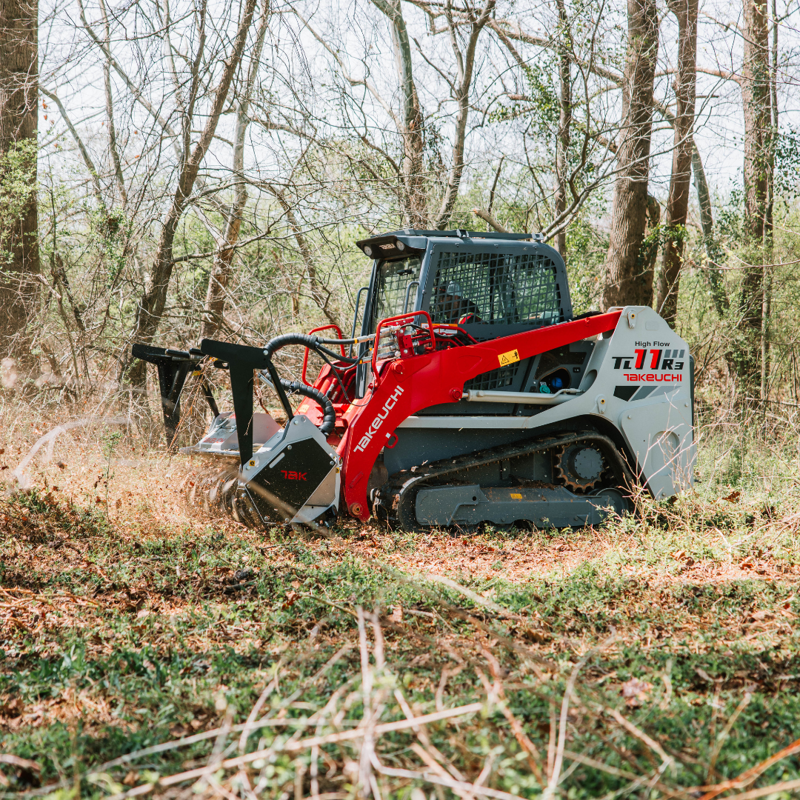
For land clearing, a forestry mulcher clears scrub and small timber in a single pass, and is one of the reasons compact track loaders have taken over so much vegetation work. These are high-flow attachments, so this is where the hydraulic specification of the base machine really counts.
A hydraulic breaker turns the loader into a demolition tool for concrete, rock and hard surfaces. Run it within its duty cycle, keep the tool greased, and it handles the breaking work that would otherwise need a separate machine on site.
Get the most from every attachment
Attachments only deliver if the machine changes them quickly and runs them reliably. A quick coupler that lets one operator swap tools without leaving the cab keeps changeover time down and keeps the machine working. Buyers comparing a track loader for sale should factor the coupler system into the decision, since fast tool changes are where day-to-day productivity is won or lost.
Takeuchi's focus on operator comfort and serviceability shows here: accessible couplers, clear hydraulic connections and a cab set up for long days all add up to more productive hours. Keep attachment maintenance on the same footing as the machine. Grease pivot points, check cutting edges and teeth, and confirm hydraulic couplings are clean and leak-free before each job. A worn or poorly maintained attachment drags down the productivity of an otherwise capable loader.
Spec your track loader and attachments with Toyota Takeuchi
The right attachment package depends on the work you do most, so it pays to plan the machine and its tools together. When you are looking at a track loader for sale, Toyota Takeuchi can help match the hydraulic specification and coupler setup to the attachments you intend to run, so the machine arrives ready for the job rather than needing a retrofit later.
Backed by genuine Takeuchi parts and the national service network of Toyota Material Handling Australia, support for both the loader and its attachments stays close at hand. To find the right track loader for sale and build an attachment package around it, talk to the Toyota Takeuchi team.